
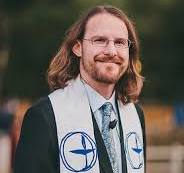
Rev. Kelly Asprooth-Jackson
First Unitarian Society of Madison
1 February, 2026
Dr. Robin Wall Kimmerer, the botanist and educator, is most likely to be known to you as the author of Braiding Sweetgrass, her extremely successful book exploring indigenous wisdom, scientific inquiry, and reciprocity between human beings and the natural world of which we are a part. Dr. Kimmerer is an enrolled citizen of the Citizen Potowatami Nation, people native to places now called Michigan, Wisconsin, and Illinois. Some years ago, she wrote an essay about her efforts to learn her own language. Bodewadmiwin, or simply Potawatomi, had been almost erased from memory like so many other native languages of this continent – by conquest, by forced migration, and by the Indian school system, which was set up by federal authorities to expunge indigenous culture, tradition, and speech from the children who were forced into it. Children including Dr. Kimmerer’s own father.
So it was with much excitement that she attended a language class at the yearly tribal gathering. A special one at which every living fluent speaker of Potawatomi in their tribe would be present to teach it. There were just nine of them. One of these teachers, Jim Thunder, a comparatively young man of only 75, opened his remarks with a long story, delivered entirely in Potawatomi. It was an animated tail, the energy and vibrancy of it visible on the storyteller’s face. He moved about in the telling of it, and as he reached his crescendo in front of an audience that largely could not understand his words, one of the other fluent speakers seated behind him on stage suppressed a giggle. Then Jim began to laugh and all the others with the knowledge to appreciate what he had said began to laugh uproariously. When all of this was done he asked, in English, “What will happen to a joke when no one can hear it anymore? How lonely those words will be when their power is gone. Where will they go? Off to join the stories that can never be told again.”
After this, Dr. Kimmerer began her earnest study of the language that was hers, though she had never been raised to speak it. So that the linguicide which the US government and a cohort of affiliated missionaries had set out to accomplish would not achieve its victory in her lifetime. And one of the many things she experienced and came to appreciate from that study was what she calls the “grammar of animacy.” In Potawatomi and other closely related languages, such as Ojibwe, a great many things that are only ever nouns in English are verbs instead. One of Dr. Kimmerer’s examples is wiikegama – “to be a bay.” This was hard to grasp as someone who was accustomed to speaking and thinking in English, but as Dr. Kimmerer puts it:
“the verb releases the water from bondage and lets it live. “To be a bay” holds the wonder that for this moment, the living water has decided to shelter itself between these shores, conversing with cedar roots and a flock of baby mergansers. Because it could do otherwise-become a stream or an ocean or a waterfall-and there are verbs for that, too. To be a hill, to be a sandy beach, to be a Saturday…all are possible as verbs only in a world where everything is alive.”
Such a framing of language ennobles what it names with beinghood, rather than diminishing it with thing-ness. As Dr. Kimmerer points out, that is a radically different orientation to the natural world than the one that our modern society has. It is also becoming more and more counter-cultural in the way that we relate just to other human beings – those to whom English normally reserves beinghood. Because our society offers a great many headings under which we can place people in order to no longer have to contend with the complexity and inconvenience of their personhood.
As many of you know, I was briefly in Minneapolis last week, along with a great many other clergy from out of town. I arrived two weeks to the day that Renee Good was killed in her car, with her wife seated beside her. I left in the early hours of the same day that Alex Pretti was executed in the street. If you do not know already, I am here to bear witness that the Twin Cities are presently occupied in the manner that a conquering army occupies an enemy state: through arbitrary violence, and the threat of it. And the rhetorical framework used to justify this unjustifiable state of affairs is the language of invasion, of illegality, of foreignness, of terrorism. Words meant to wipe away all rights, all process of law, all human decency, like some malevolent incantation. To render whole classes of people, and anyone who could be confused with them, and anyone who might commit the crime of empathy for them, from beings into mere things. It is by this language that Alex and Renee were killed, just as countless of their neighbors were harassed, abducted, disappeared, exiled, and in several cases killed as well.
I know that there is someone here today – many someones, I expect – who came to hear a good word of solace and encouragement in your living. I know it is hard to face these hard things as they are, and that most of us feel ground down daily as we do face them alone, through the narrow windows of our phones. My obligation to you is the truth, and the truth is a mirror. It must reflect both the light and the absence of it, in the world that it looks upon.
And if I did not express to you honestly how bad things are in Minneapolis, I would not be able to share with you faithfully how beautiful the people there are. How such a wide and vast range of human beings have refused to let inhumanity make them inhumane. How many of those most affected have pulled together to help each other and to persist despite very real and present danger. And how a great many more people, people who look like me and could probably expect to be left alone if they sat quietly and pretended not to see, have instead decided to act. Children need to get to school – my children, and everybody else’s – so folks started defensive carpooling. If you can’t leave your home without increasing the risk of being abducted, you can’t get to work, you can’t get paid, and you can’t afford important things like food or rent. So folks set up delivery services for food pantries, they started funds for rent, and groceries, and diapers for strangers. Strangers only in the sense of not knowing the other person’s face or name or story. But neighbors in every sense that matters. It was an honor to be a guest in a place like that. It was a warning, to prepare for the possibility of similar conditions in my own community. And it was a lesson about how powerful embracing the beinghood – the full, infinite worthiness – of everyone who makes up a community can be.
For some white, middle-class folks – myself included – the killings of Renee Good and Alex Pretti – people who very easily and naturally remind me of me – was a shock that demanded a new level of attention, no matter how tuned in or tuned out we were beforehand. I wish that we lived in a world where everyone was as unaccustomed as I am, to seeing people who look like them shot in the street by armed men sent by the government. If you are feeling that same heightened level of attention, my counsel is to hold onto it, figure out how you can act on it, based on your own specific ability and capacity and resources, while staying grounded in the truth that Alex and Renee were motivated by care for and solidarity with people who do not look like them. Because defending the fundamental humanity of immigrants – and those who might be mistaken for immigrants – was identical to them with defending their community as a whole.
When we wake up to the full beinghood of someone else, any someone elses, it can be a great shock. According to tradition, the Quran, the holiest text in Islam, was delivered through the Prophet Muhammad in a series of revelations. These were striking episodes, in which Muhammad would enter a trance-like state and recite a new piece of poetic verse – with the length and the subject matter varying quite broadly. In the Islamic understanding, these were words coming directly from God, and so they arrived on God’s timetable – not always at times that were convenient for Muhammad. The tradition includes many stories about when, where, and under what circumstances a given verse or passage was revealed.
In one of those stories, Muhammad was talking with some rich, powerful members of the community about this new religion of Islam he was trying to get started. The rich people weren’t really into it, but he was working hard and focused on trying to win them over. While he was engaged like this, another member of the community – a blind man, and rather poor – heard Muhammad’s voice and came rushing up to him. He had heard talk about Islam and was very interested to learn more. He began to pepper the Prophet with questions. But Muhammad was focused on trying to win these powerful converts, and so he turned his back on the blind man.
This is when the revelation struck him; words now incorporated as the opening verses of the 80th chapter of the Quran which, very loosely translated, are:
He frowned and turned away
Because a blind man interrupted him…
…One who thinks they have no need
To them you give attention…
…But the one who came to you seeking
With God in his heart
From him you are distracted.
Which would have been a fairly sharp rebuke if someone said it to you right after you’d turned away a blind man who wanted to join your religion. But remember, according to the story God made Muhammad say it out loud, about himself, to everyone. The tradition holds that after that revelation, Muhammad made a point of greeting that same man warmly each time that they met, and asking what he could do for him. The blind man did become a Muslim, and ultimately an important political figure and a leader in the early religious community.
Letting go of the pride that causes us to cling to our mistakes and failings can sometimes be the hardest thing in the world, and it applies just as much on the scale of the personal as it does on the scale of a nation or a planet. But that overabundance of pride also closes us off from others, causing us to turn away from connection and belonging. When we let go of it, the feeling can be quite revelatory: new relationships and new possibilities in existing relationships unfold, including our own relationship with our selves.
One of the stories that Dr. Rachel Naomi Remen collects in her book, Kitchen Table Wisdom, comes from her interview with a man named Yitzak. Yitzak, a holocaust survivor, was attending a retreat for people living with cancer. That was the only thing the people there had in common – they were, otherwise, strangers. Yitzak struggled to connect in such an environment, and ultimately took that struggle into prayer. Dr. Remen quotes him saying, in his dialect:
“…I say to Him, ‘God is it okay to luff strangers?’ And God says to me, ‘Yitzak, vat is dis strangers? You make strangers. I don’t make strangers.’”
How different would our world be if each of us lived, each day, grounded securely in the understanding that God does not make strangers? That every person is worthy of being loved, and that when we say “every person,” we have to include ourselves. The quality of kindness, of acknowledging that others are worth acknowledging and caring about, opens the way to understanding and then to belonging. It can never be excessive in an absolute sense. The only dangers in such compassion are not to have enough of it at all, or to have it in too uneven a proportion: treating some well and others harshly, forgiving others too easily compared to ourselves, or vice versa.
Joanna Macy, the environmental activist and Buddhist scholar, wrote in her book Coming Back to Life, about healthful approaches to addressing the psychological and spiritual struggle posed by climate change and ecological devastation. I know that we often separate social justice from environmental justice, but I find in her words a great summary of the imperative that I hear in Robin Wall Kimmerer’s grammar of animacy: not simply to endure the present world but to build a new and better one. Here are Joanna Macy’s words:
“It is no longer appropriate to think only in terms of even my nation or my country, let alone my village. If we are to overcome the problems we face, we need what I have called a sense of universal responsibility rooted in love and kindness for our human brothers and sisters. In our present state of affairs, the very survival of humankind depends on people developing concern for the whole of humanity, not just their own community or nation. The reality of our situation impels us to act and think more clearly. Narrow-mindedness and self-centered thinking may have served us well in the past, but today will only lead to disaster.”
This past Friday, at a demonstration here in Madison, I saw some words transcribed onto one of the protest signs. They came from an essay by Dr. Sarah Kenzior, an anthropologist whose focus of study includes both totalitarian states, and the American Middle West. Her words, I think, encapsulate well what I saw and was inspired by in Minnesota – the determination of a community to resist an armed agenda trying to make multi-racial, multi-cultural, inclusive democracy into a story that can never be told again. My friends, I hope that you will take Dr. Kenzior’s words into your heart, for the days and years ahead of us:
“Do not accept brutality and cruelty as normal even if it is sanctioned. Protect the vulnerable and encourage the afraid. If you are brave, stand up for others. If you cannot be brave – and it is often hard to be brave – be kind.”